MRICS SOE: Why Language Matters More Than You Think
When working towards your MRICS, your Summary of Experience (SOE) is more than just a record of what you’ve done—it’s how you demonstrate your competence in a way that assessors can clearly understand and evaluate.
A common issue is not lack of experience, but how that experience is communicated. The difference between a pass and a referral often comes down to structure, clarity, and the language used across the three competency levels defined by the Royal Institution of Chartered Surveyors.
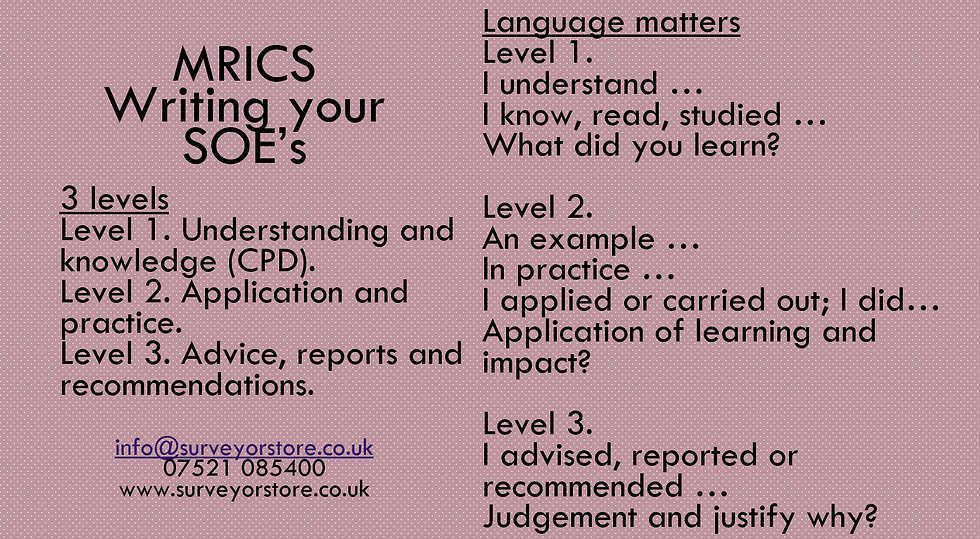
The Three Levels – Done Properly
Each level builds on the last. If your wording doesn’t reflect that progression, assessors will struggle to place your competence accurately.
Level 1: Knowledge and Understanding
At this level, you are demonstrating what you know—not what you’ve done.
Strong statements include:
“I understand…”
“I have knowledge of…”
“I have studied…”
But don’t stop there. The key question is: what did you actually learn?
Link your knowledge to standards, guidance, or industry practice where possible. This shows structured understanding rather than surface-level awareness.
Level 2: Application and Practice
This is where knowledge becomes action.
It’s not enough to say “I did…”—you need to show how you applied your knowledge in real situations.
Use phrases such as:
“In practice…”
“An example of this is…”
“I applied…” or “I carried out…”
Most importantly, answer this: how did you apply your knowledge, and what was the outcome or impact?
Assessors are looking for evidence that your involvement made a difference—whether that’s improving a process, informing a decision, or managing risk.
Level 3: Advice, Reports and Recommendations
This is the level that demonstrates professional judgement—and where many candidates fall short.
Here, your role goes beyond doing. You are influencing.
Use clear, confident language:
“I advised…”
“I reported…”
“I recommended…”
Then go further:
What was your professional judgement?
Why was your advice appropriate?
Justification is critical. You need to explain the reasoning behind your decisions and show that your advice was based on sound professional thinking and relevant factors.
Why Language Matters
Assessors are not mind readers. If your wording is vague, passive, or too general, your competence may be underestimated—even if your experience is strong.
Good SOEs are:
Clear and structured
Focused on evidence, not description
Written with purpose at each level
Think of it this way:
Level 1 shows what you know
Level 2 shows what you do
Level 3 shows how you think and advise
Final Thought
Your SOE should tell a clear story of progression—from knowledge, to application, to professional judgement.
If you get the language right, you make it easy for assessors to see your competence. If you don’t, you risk underselling your experience.
If you need support refining your SOE or preparing for your assessment, consider reaching out to Surveyor Store for further guidance.
Sarah Chaudhry MBA FRICS
Director
Surveyor Store Ltd
07521 085400
Comments